


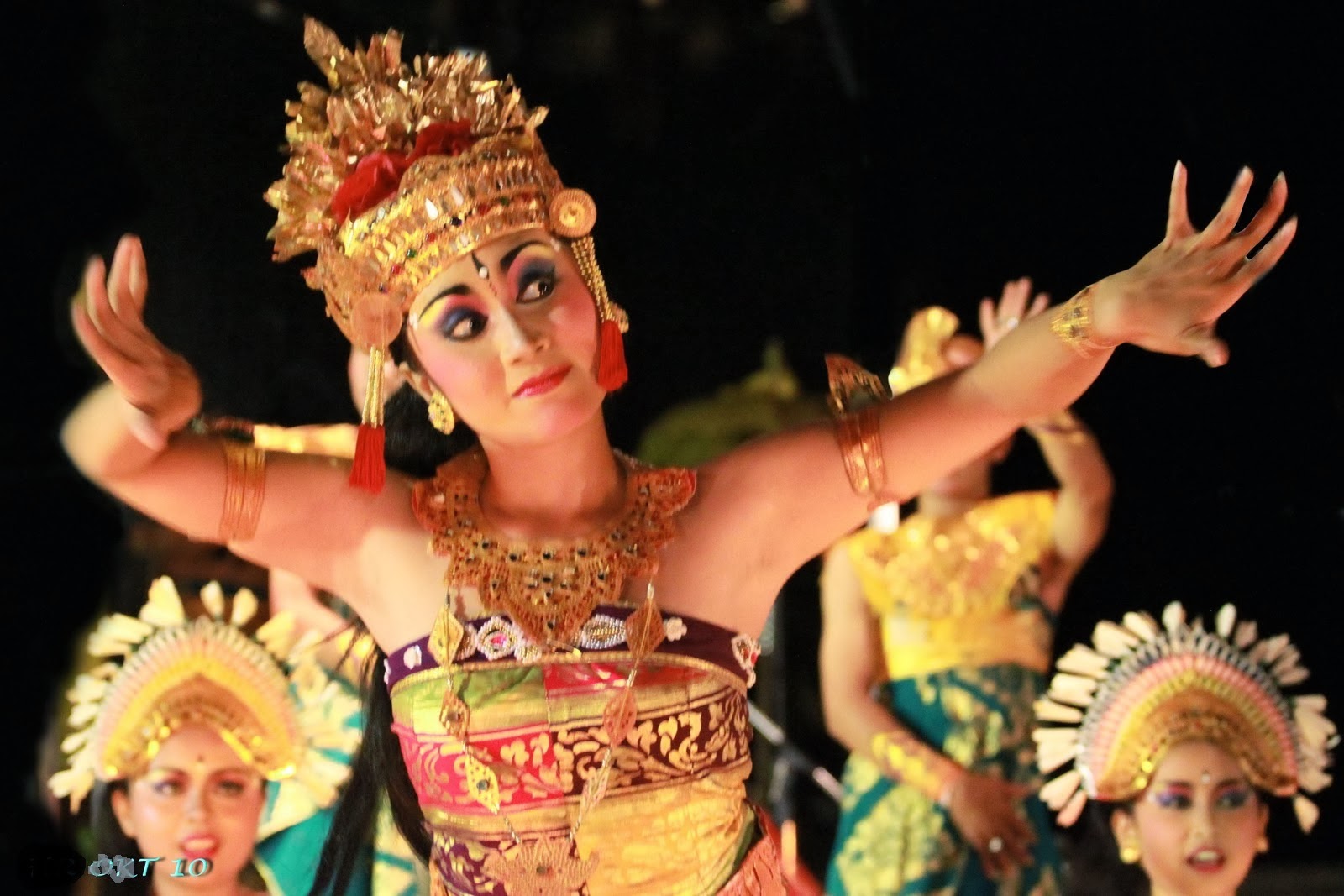


The term barong can refer to a mythological animal mask in general. In practice, however, it usually means Barong, a mythical animal figure known to all Balinese. Inside its hairy body are two male dancers, whose movements and steps must be completely co-ordinated to perform its fast turns and leaps. The forward dancer supports and moves the head and jaws.
The decorative, slightly Chinese-influenced Barong mask is stylistically related to the old wayang wong masks. The Barong mask has bulging eyes, large ears, and a headdress of gilt leather and shining pieces of mirror, and large ears. Similarly, the upright tall and the ornaments of the hairy body, made of the same material, glimmer along with the Barong’s movements.
The Barong figure is believed to have its roots in the ancient Chinese lion dance, which is still performed at New Year celebrations everywhere in the Chinese world. The lion dance was also previously common on many islands in Indonesia. Later, the Balinese lion figure acquired its own features, and became a creature combining various elements in a way typical only of Bali.
Barong is not actually a lion, but a composite of various animals. The Barong types are named according to the dominating animal figure: Barong Asu combines the features of a dog and a lion, while Barong Machan resembles a tiger, the Barong Lembu has the shape of a cow, and the Barong Bankali has the features of a wild boar.

Grossly simplified, Barong is usually described as a manifestation of virtue. It is, however, too capricious and unpredictable to be interpreted unequivocally as such. Nevertheless, Barong is revered as the protector of villages, and its outfit and mask are regarded as sacred. During festivities, the Barong figure is carried around the village to the accompaniment of music. Each banjar or village council has at least one Barong mask and outfit of its own.
The Barong figures are given human and identifiable traits. The history of many Barongs is known, particularly those regarded as exceptionally magical, and their reputation has spread throughout the island. On some occasions Barong is taken to a neighbouring village to meet his lover, and grand gatherings of many Barongs occasionally take place. In practice, the Barong processions, games, and gatherings are also a way for young men and women from neighbouring villages to become acquainted with one other.
Along with the various types of processions, specific forms of drama have evolved around Barong. Possibly the oldest of these is the hereditary Barong Kedingkling, a form of sacred dance-drama developed in the eighteenth century to ward off an epidemic. In this drama Barong appears together with monkey characters borrowed from the Ramayana.
The performance lasts all day, beginning in the village temple and dispersing later throughout the village. The monkeys accompanying Barong are permitted various forms of mischief, such as pilfering food and well-meant teasing. Many villages have their own versions of this tradition. Barong is also a central figure in the Calonarang drama, and modern, non-ritual Barong dramas have been developed mainly for tourist shows


